Skin Structure, layer by layer.
The complex layers that make up your skin, and how treatments work at each depth.
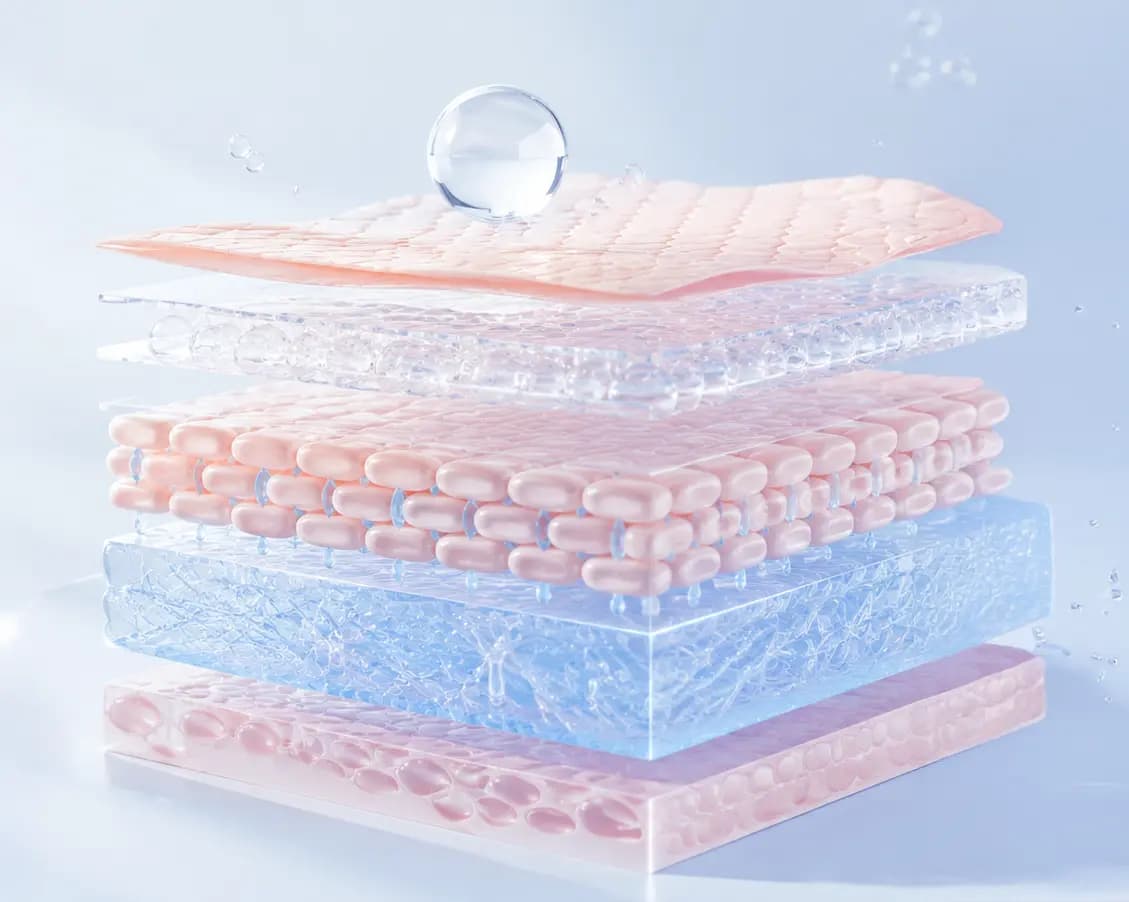 Three floors of skin
Ask most people what skin is made of, and you'll get a one-word answer: skin. It looks like a single surface, so it's easy to think of it as one uniform thing wrapped around the body. In reality, skin is closer to a building with several distinct floors, each with its own job, its own architecture, and its own set of problems that show up when something goes wrong.
This matters more than it sounds like it should, because it explains something that trips up a lot of skincare routines: why the same active ingredient can work brilliantly for one concern and do almost nothing for another. Often, the difference isn't the ingredient. It's whether that ingredient ever reached the layer where the problem actually lives.
The three floors of skin
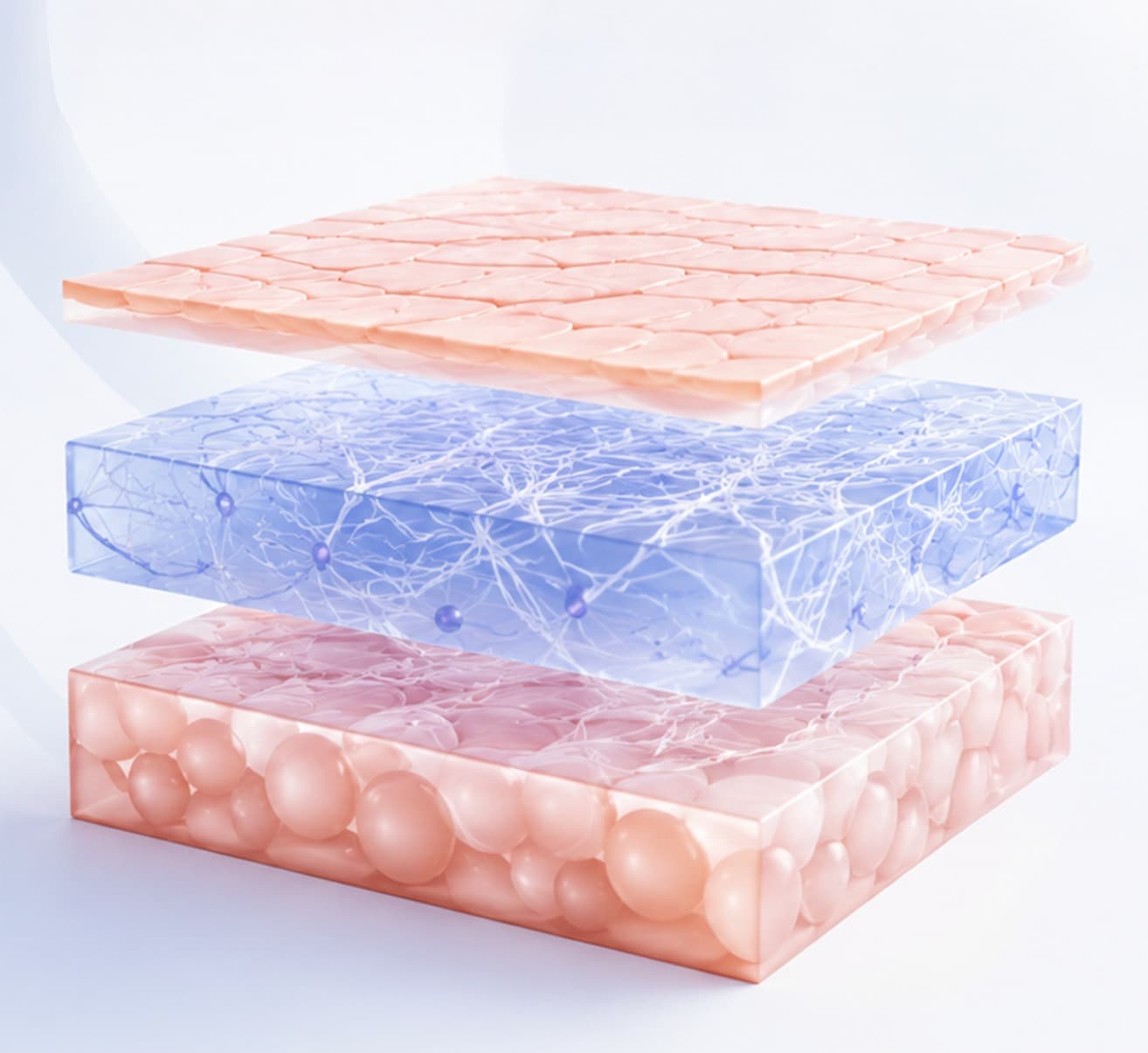
Epidermis
Surface layerThis is the layer you actually see and touch. It's thin, it's constantly renewing itself, and its outermost part, the stratum corneum, is what most skincare products are designed to interact with first. The epidermis is where pigment-producing cells called melanocytes live, which is why almost every pigmentation and tone concern starts here. It's also home to the skin barrier, the structure responsible for keeping moisture in and irritants out.
Dermis
Mid layerSitting beneath the epidermis, the dermis is thicker and denser, built from collagen and elastin fibres that give skin its firmness and bounce. This is where blood vessels, nerve endings, hair follicles, and oil glands sit. Concerns like fine lines, loss of elasticity, and deeper inflammatory processes tend to originate here, not at the surface. This is also the layer that's genuinely difficult to reach, most topical products, no matter how well formulated, struggle to get meaningful concentrations of active ingredients this deep.
Hypodermis
Deep layerThe deepest layer, made mostly of fat and connective tissue, anchors the skin to muscle and bone underneath. It plays a role in insulation, cushioning, and energy storage. Skincare rarely targets this layer directly, though it's relevant to how skin ages and loses volume over time.
Why depth changes everything about treatment
Here's the part that gets overlooked constantly: a concern's depth determines what kind of intervention can actually fix it.
A concern sitting purely at the surface, dullness from a buildup of dead skin cells, for example, responds well to something as simple as exfoliation, because the problem never left the outermost layer to begin with. But a concern like stubborn pigmentation often has both a surface component and a deeper one. Melanin sits visibly in the epidermis, but the melanocytes producing it are influenced by inflammatory signals that can originate in the dermis. Treat only the surface, and the pigmentation fades briefly before returning, because the source was never addressed.
This is why so many pigmentation treatments plateau. A product might be excellent at inhibiting melanin production at the surface, but if it can't reach the layer where inflammatory triggers are keeping melanocytes overactive, the results stay partial and temporary.
The delivery problem no one talks about
Getting an active ingredient into the right layer, at a concentration that actually does something, is one of the harder unsolved problems in skincare. Skin's own barrier, the same structure that protects it from the outside world, is specifically built to keep most substances from getting through. That's a feature when you're thinking about pollution and bacteria. It's a frustration when you're trying to deliver a treatment to the dermis.
This is where formulation technology starts to matter as much as the active ingredient itself. Two products with the same percentage of the same acid on the label can behave completely differently in practice, depending on whether the formulation actually gets that acid where it needs to go, and keeps it there long enough to work.
A treatment built around this exact problem
This is precisely the gap Aztra-X™ was formulated to close. Aztra-X™ is Monoskin's duo-therapy for de-pigmentation, combining Azelaic Acid 15% with Tranexamic Acid 3%, and it's built specifically around the idea that pigmentation is rarely a single-layer problem. It's positioned as a first-line treatment for melasma at both the dermal and epidermal level, which is a meaningful distinction. Most de-pigmenting formulas work primarily at the surface. Aztra-X™ is designed to act at both depths at once.
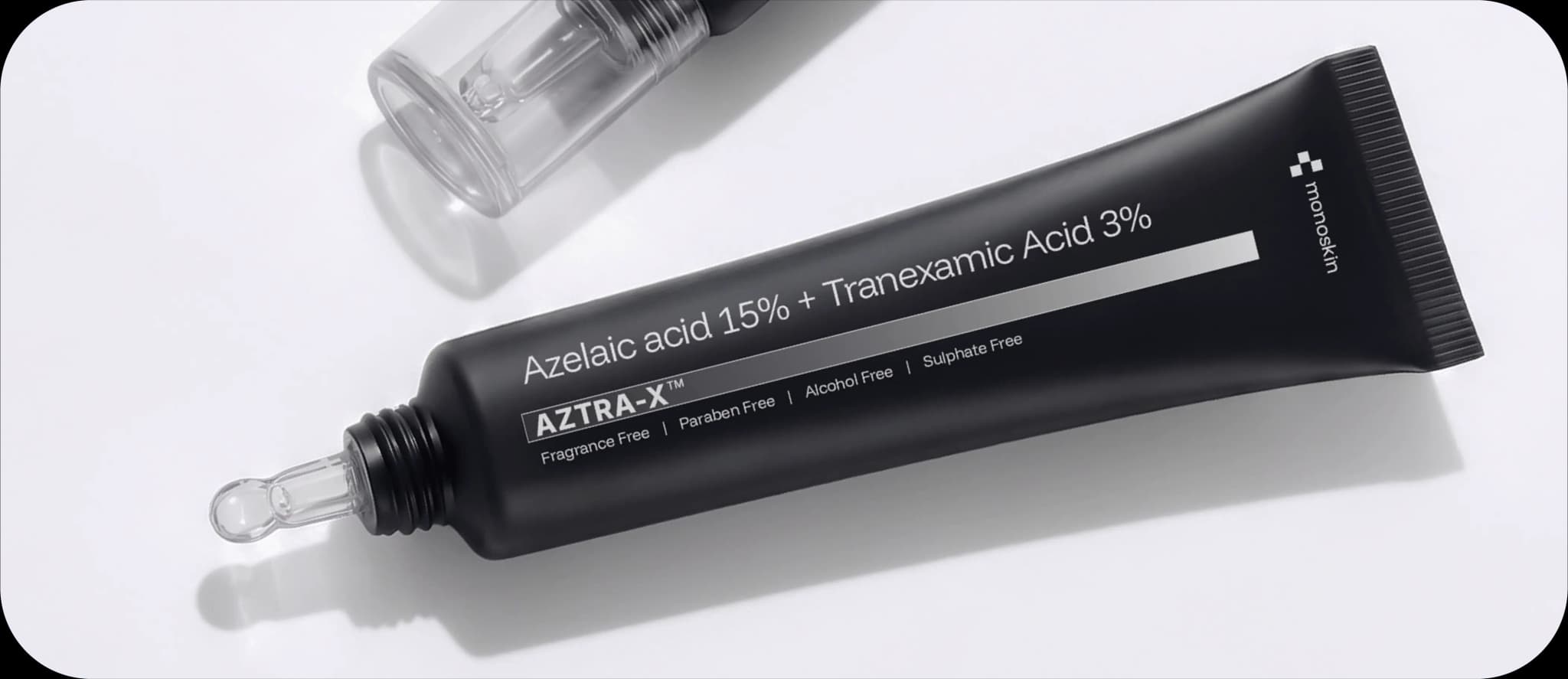
The two actives split the work by mechanism. Azelaic Acid functions as a tyrosinase inhibitor, blocking melanin production at the enzymatic level, a surface-adjacent, epidermal action. Tranexamic Acid works as a plasminogen inhibitor, reducing melanocyte activity through inflammatory pathways that often originate deeper, in the dermis. Used together, the formulation addresses both where the pigment shows up and what's driving its production in the first place, which is a large part of why it's positioned for stubborn, recurring dark patches and rosacea-related redness, not just surface discoloration.
Azelaic Acid 15%
A tyrosinase inhibitor, blocking melanin production at the enzymatic level near the surface.
Tranexamic Acid 3%
A plasminogen inhibitor, reducing melanocyte activity through inflammatory pathways deeper in the dermis.
What this means for how you think about your routine
The practical takeaway isn't that every product needs to reach the dermis. Plenty of concerns are genuinely superficial, and treating them that way is the right call. But for anything that's proven stubborn despite a reasonable routine, pigmentation that keeps returning, redness that won't settle, texture that a surface-level exfoliant hasn't touched, it's worth asking a different question than "is this the right ingredient." The better question is often: is this treatment actually built to reach the layer where the problem lives.
Skin isn't one surface to treat. It's several layers, each demanding a different approach, and the treatments that work best long-term tend to be the ones built with that structure in mind from the start, which is exactly the thinking behind Aztra-X™.
Aztra-X™ is a Micro-Pharmacy Exclusive with limited dispensing. Ask your Monoskin representative for exclusive partner terms and availability.