Androgenetic Hair Loss (Alopecia)
The most common form of hair loss, and what current approaches actually target.
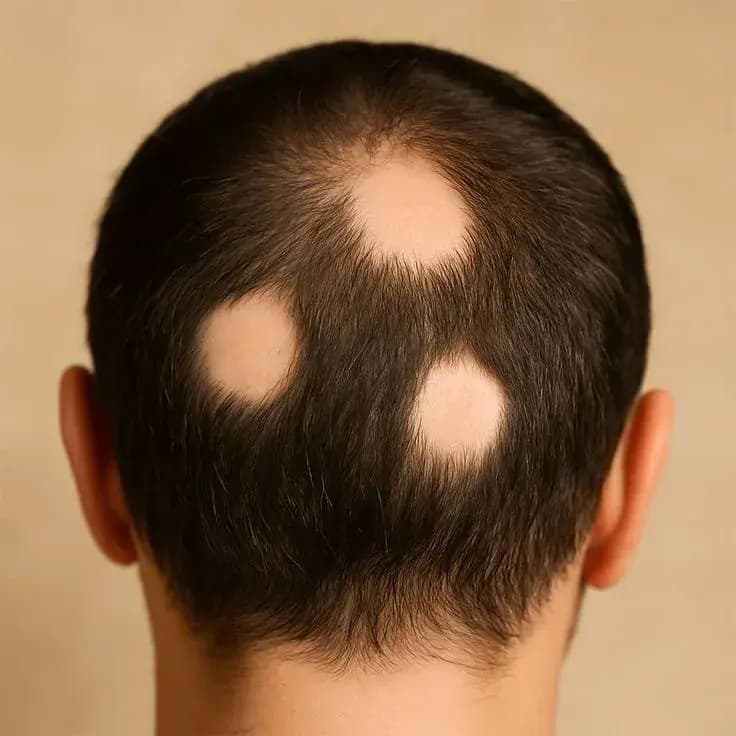 Hair condition
Androgenetic alopecia is the most common cause of hair loss worldwide, affecting a significant percentage of both men and women over their lifetime. Despite how common it is, it's frequently misunderstood as simply an inevitable part of aging, when it's actually a specific, mechanism-driven process.
What is androgenetic alopecia?
Commonly known as male or female pattern hair loss, it's a progressive form of hair thinning caused by the gradual miniaturization of hair follicles. Over time, affected follicles produce increasingly finer, shorter hairs, until they eventually stop producing visible hair altogether. It follows a genetically determined, often predictable pattern of progression, which distinguishes it from other, more diffuse forms of hair loss.
What causes androgenetic alopecia?
The condition is primarily driven by dihydrotestosterone, or DHT, a hormone derived from testosterone. In genetically predisposed follicles, DHT binds to receptors and gradually shortens the hair growth cycle, leading to progressively finer regrowth over successive cycles. Genetics determine which follicles are sensitive, which is why the condition tends to follow family patterns and predictable areas, the crown and hairline in men, and more diffuse thinning along the part line in women.
What does it look like?
In men, it typically presents as a receding hairline and thinning at the crown, often progressing according to well-documented patterns. In women, it more commonly presents as diffuse thinning across the top of the scalp, with the frontal hairline generally preserved. Unlike telogen effluvium, it's typically gradual and progressive rather than sudden, and it doesn't resolve on its own without intervention.
How is androgenetic alopecia treated?
Because the condition is progressive, earlier intervention is generally associated with better outcomes. Treatment approaches vary, including options that address hormonal activity at the follicle level, and options focused on supporting the hair growth cycle, scalp environment, and follicle health more broadly. Current research increasingly supports multi-pathway approaches, addressing circulation, inflammation and follicular signaling alongside hormonal factors, rather than relying on a single mechanism.
How does nanogrow™ approach it?
nanogrow™ is formulated as a non-minoxidil option, built around a four-pathway architecture targeting follicular penetration, hair loss and growth, hydration and scalp support, and hair shaft repair.
For hair shaft repair it includes Glaudin™ and saw palmetto, an ingredient that has drawn research interest for its potential role in addressing hormonal contributions to hair thinning without functioning as a systemic hormonal treatment. This is paired with Nigella sativa, Anagain and oat beta-glucan for hair loss and growth support, and Glucaveen™ and panthenol for hydration and scalp support, reflecting a broader, multi-pathway approach to a condition that current research increasingly understands as multi-factorial.
When should you see a dermatologist?
Because androgenetic alopecia is progressive, it's generally worth consulting a dermatologist early, particularly if hair loss is noticeable, accelerating, or a source of concern, since earlier treatment is typically associated with better long-term outcomes than waiting until thinning is advanced.
A note from Monoskin
Androgenetic alopecia is a specific, progressive process, not an inevitability, and current understanding increasingly supports addressing it from multiple angles rather than one. nanogrow™ was formulated around this multi-pathway understanding. If hair thinning is progressing or concerning, consult a dermatologist about the most appropriate treatment approach.