Telogen Effluvium
Why hair suddenly starts shedding, and what actually helps it recover.
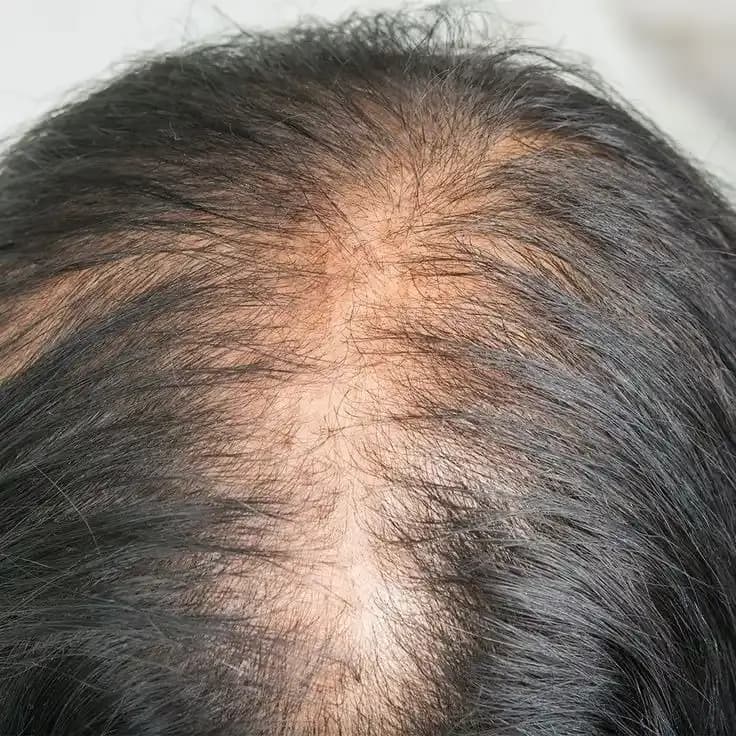 Hair condition
Noticing significantly more hair than usual in the shower drain or on a hairbrush can be alarming, and it's one of the more common reasons people seek help for hair loss. Often, what's happening isn't permanent hair loss, but a temporary, explainable shift in the hair growth cycle known as telogen effluvium.
What is telogen effluvium?
Hair naturally grows in cycles, moving through a growth phase, a transitional phase, and a resting phase, after which the hair sheds and a new one begins growing. At any given time, roughly 10 to 15 percent of hair is in this resting, or telogen, phase. Telogen effluvium occurs when a larger-than-normal percentage of hair follicles are pushed into this resting phase simultaneously, resulting in noticeable, diffuse shedding roughly two to three months later.
What causes telogen effluvium?
It's typically triggered by a significant physical or emotional stressor to the body. Common triggers include high fever or illness, major surgery, significant weight loss, nutritional deficiencies (particularly iron or protein), thyroid imbalances, certain medications, and high emotional or psychological stress. Childbirth is also a well-recognized trigger, due to the sharp hormonal shift that occurs afterward.
What does telogen effluvium look like?
Unlike patterned hair loss, telogen effluvium typically causes diffuse thinning across the entire scalp rather than in a specific pattern. Shedding is often noticeably increased, and because it follows the triggering event by two to three months, the connection to the underlying cause isn't always obvious at first. In most cases it resolves on its own within six to nine months once the underlying trigger is addressed. Because it's a cycle disruption rather than follicle damage, most people see regrowth once the cause is resolved, though this process takes time.
How does nanogrow™ support recovery?
nanogrow™ is built around a four-pathway architecture targeting follicular penetration, hair loss, hydration and scalp support, and hair shaft repair, which aligns well with the multi-factorial nature of telogen effluvium recovery.
For hair loss and growth support it includes Nigella sativa, Anagain and oat beta-glucan. For hydration and scalp support, relevant to follicle health during a resting-phase disruption, it includes Glucaveen™ and panthenol. Supporting actives such as niacinamide, biotin and caffeine round out the formulation. As a non-minoxidil option, nanogrow™ is positioned for people looking to support the hair cycle and scalp environment without a hormonal treatment approach.
When should you see a dermatologist?
If shedding is severe, doesn't improve within several months, or there's no clear triggering event, it's worth seeing a dermatologist to rule out other causes, including thyroid dysfunction or an underlying nutritional deficiency, and to confirm the diagnosis.
A note from Monoskin
Telogen effluvium is usually temporary, and understanding the underlying trigger is often more useful than panicking about the shedding itself. nanogrow™ was formulated to support the scalp and hair cycle during this recovery window. If shedding is severe or prolonged, consult a dermatologist to identify the underlying cause.